
The Business Case for In-House Nitrogen Generation

Executive summary
For many UK manufacturing sites, nitrogen is a critical utility rather than an occasional consumable. When volumes rise, delivered nitrogen (cylinders or bulk liquid) can become expensive, operationally disruptive and vulnerable to logistics issues.
In-house nitrogen generation addresses those constraints by producing gas on demand from compressed air. The commercial case is usually strongest where consumption is steady, where production is continuous, or where downtime caused by supply interruptions carries a high cost.
- Lower delivered-gas spend, typically improving total cost per cubic metre at higher usage levels
- Improved resilience by reducing reliance on deliveries and cylinder handling
- Better control of purity by matching specification to process needs
- Reduced site hazards compared with extensive cylinder storage or cryogenic tanks
Why manufacturers are moving to on-site generation
Manufacturers are reassessing nitrogen supply models due to rising operating costs, tighter production schedules and a stronger focus on supply continuity. Where nitrogen use is frequent, the administrative burden of ordering, storing and managing deliveries can become a hidden cost as well as a risk.
Adoption has accelerated in:
- Analytical and testing laboratories
- Food and beverage packaging
- Electronics and semiconductor manufacturing
- Pharmaceutical and life-science production
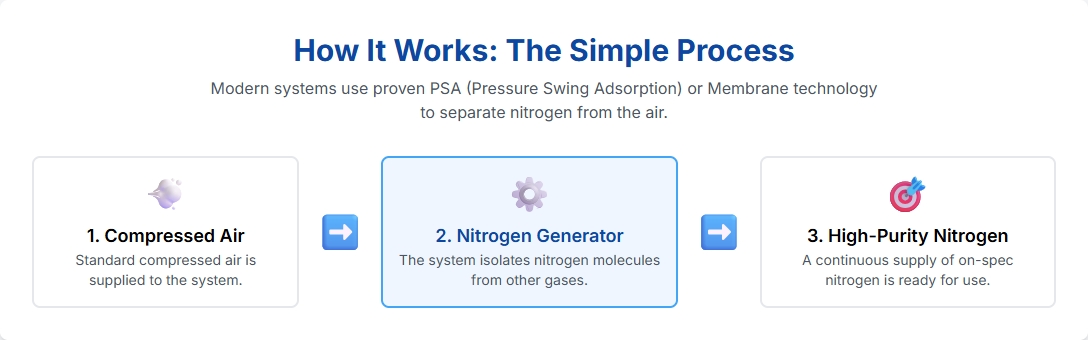
How nitrogen generators work
Most industrial systems use either pressure swing adsorption (PSA) or membrane separation. Both rely on pre-treated compressed air and a separation stage that concentrates nitrogen while venting oxygen and trace gases.
PSA (pressure swing adsorption)
PSA systems use carbon molecular sieve media to preferentially adsorb oxygen under pressure. Twin-tower configurations alternate between adsorption and regeneration to provide a continuous nitrogen stream.
Membrane separation
Membrane systems use hollow-fibre membranes that allow oxygen to permeate more readily than nitrogen. They are typically simpler and well-suited to lower-to-mid purity requirements, depending on flow demand.
Purity control
A key advantage of on-site generation is matching purity to the process. Higher purity generally requires more energy and/or lower yield, so specifying only what you need can reduce operating cost.
Financial case and ROI logic
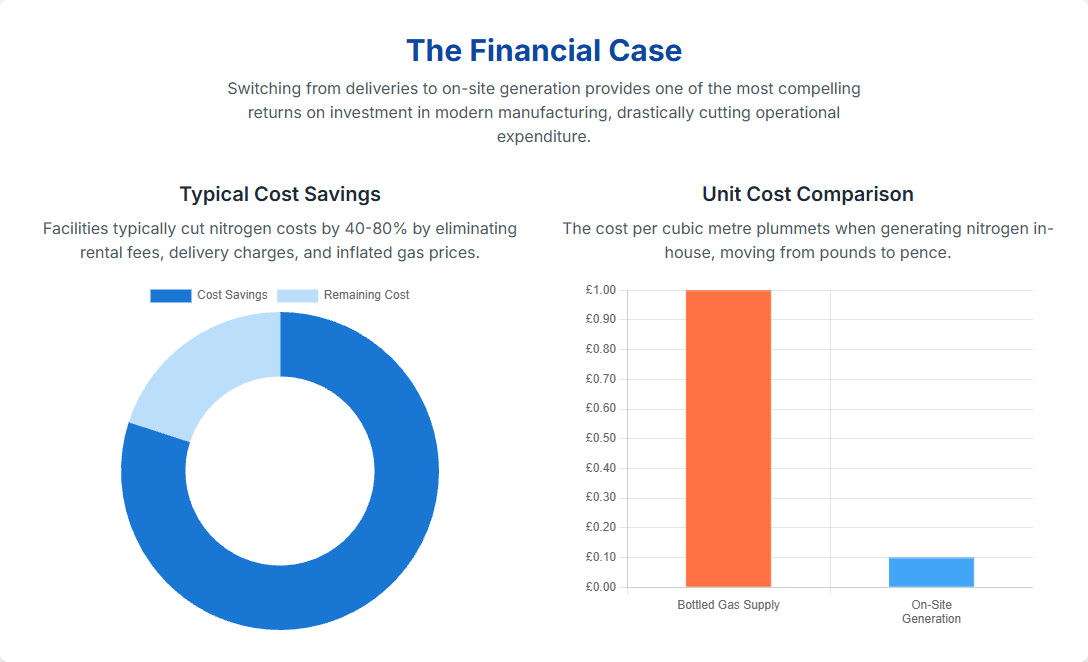
The economic case depends on consumption, required purity, electricity cost, compressor efficiency and the current delivered-gas price. For high-usage sites, on-site generation often shifts cost from repeated purchases to predictable operating expenditure, supported by a one-time capital investment.
Cost reduction drivers
- Lower unit cost at steady flow rates compared with cylinders and frequent deliveries
- Reduced handling time, fewer changeovers and lower administrative overhead
- Less exposure to delivery variability and emergency orders
Payback logic
Payback is typically evaluated by comparing the current annual delivered-nitrogen spend (including rental, delivery and handling impacts) against the projected annual operating cost of the generator (electricity, service parts and planned maintenance). Sites with continuous demand generally see the clearest payback profile.
Operational resilience
Removing dependency on scheduled deliveries can reduce the risk of production disruption. For 24-hour operations, this is often as important as the unit-cost benefit, particularly where nitrogen is interlocked with process equipment.
Environmental and compliance benefits
On-site nitrogen generation can support environmental and safety objectives by reducing cylinder movements and limiting the need for large on-site stocks. It also enables tighter control over operating conditions and maintenance planning.
From a sustainability perspective, impacts depend on how electricity is sourced and how the previous supply chain was configured. Where purity is optimised and systems are correctly sized, energy use can be kept proportional to demand.
Request a nitrogen cost analysis
If you can share your typical flow rate, purity requirement and current supply method, ALS can model the commercial case and propose a system sized for your site.
Next steps
In-house nitrogen generation is a mature option for manufacturers that rely on nitrogen daily. The right outcome depends on correct sizing, purity specification and integration with your compressed air system.
- Confirm demand profile (peak, average and duty cycle)
- Define purity at point of use and any applicable quality requirements
- Review compressor capacity, air quality and distribution losses
- Compare total delivered-nitrogen costs with projected operating costs
ALS Industrial Services supplies and maintains complete nitrogen generation systems designed for long-term performance, with service support and integration expertise for UK manufacturers.