
Andy Crammond and the Bronze Age gold find making national headlines
Key facts
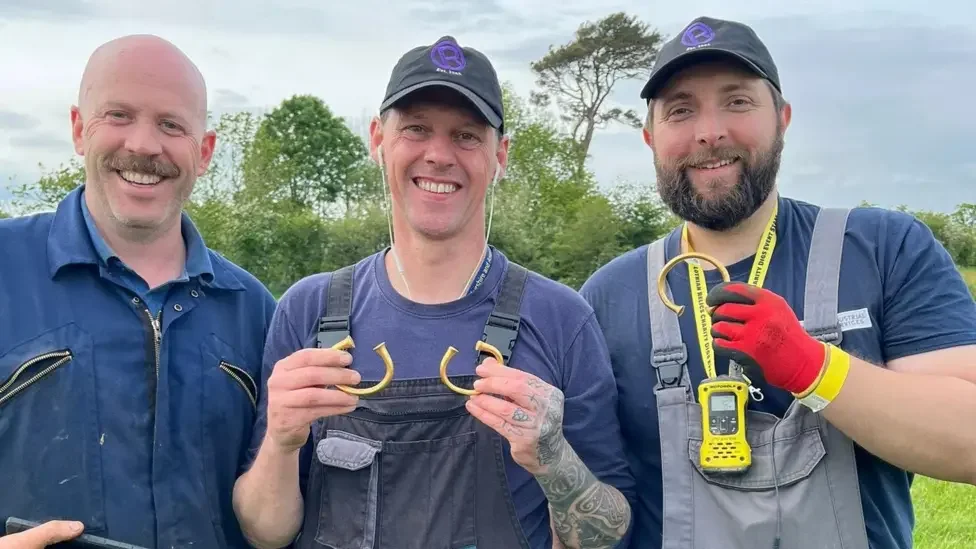
- Andy Crammond, ALS field service engineer for Scotland, and fellow detectorist Alan Daniels discovered three Bronze Age gold torcs near Carlisle on 23 May 2026.
- All three torcs were intact. Finding even one complete Bronze Age gold torc is considered rare in British archaeology. Finding three in a single dig has been described as ‘spectacular’.
- The artefacts were found during a metal detecting rally organised by Lothian Relics Metal Detecting on land owned by farmer Richard Forbes in the Blackford area north of Carlisle.
- The torcs were almost certainly placed deliberately, either as part of a burial or as a hidden hoard, suggesting organised Bronze Age activity in the area.
- The find adds to growing evidence of a prehistoric trade route running from Ireland, across the Irish Sea, and into the Eden Valley, predating the Viking-era connections Cumbria is already known for.
- The site is under consideration for a National Grid electricity substation. Campaigners and local councillors are calling for it to be designated archaeologically significant in light of the discovery.
The rally and its background
The land in question sits north of Carlisle, in the Blackford area of Cumbria. It is one of several sites National Grid has been considering for a new electricity substation, a proposal that has generated significant local opposition through a campaign group called North Carlisle Against the Substation and Pylons.
As part of efforts to draw attention to the site’s potential historical significance, the campaign group invited Lothian Relics Metal Detecting to carry out a rally on land owned by local farmer Richard Forbes. The idea was straightforward: if there was archaeological material in the ground, a structured detecting rally was a reasonable way to find out.
The discovery
Andy Crammond travelled from Scotland with fellow detectorist Alan Daniels to take part in the rally on 23 May. The early part of the day produced the kind of finds typical of most detecting outings: a few old coins, the usual assortment of scrap. Nothing that suggested what was coming.
When the pair uncovered the first of the gold torcs, the day changed entirely. Alan Daniels described it as ‘the holy grail of metal detecting finds.’ There were not one but three of them, all in the same field, all intact.
Before the find
A standard rally day: experienced detectorists working a Cumbrian field, expecting modest results at best. The campaign group had hoped the exercise might surface some evidence of historical activity. Roman or medieval material was considered the realistic ceiling.
What came out of the ground
Three complete Bronze Age gold arm rings, thousands of years old. A find that prompted immediate calls to archaeologists and has since been reported across national media. Gary Robertson described the experience of holding them as extraordinary.
The torcs: a closer look
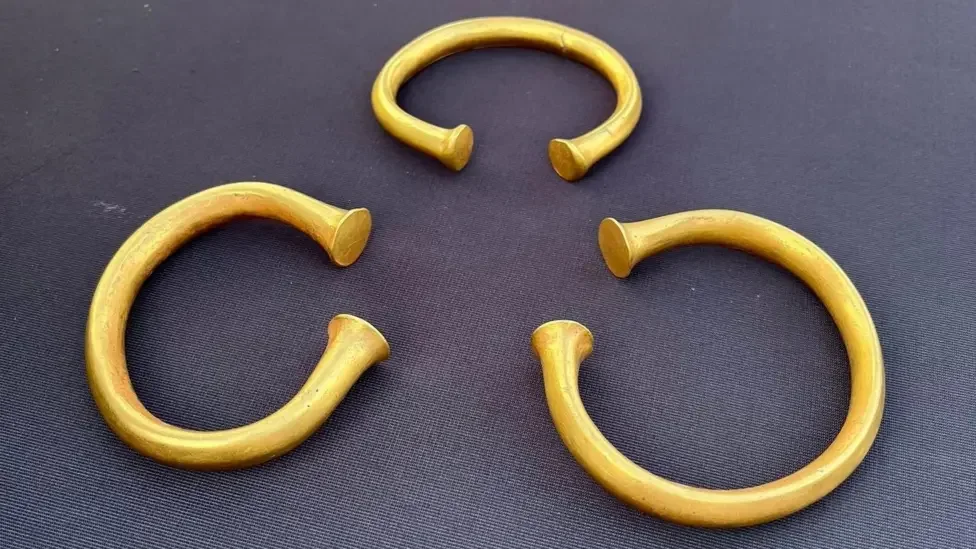
A torc is a rigid or semi-rigid metal ring, typically worn on the upper arm as a high-status object. In the Bronze Age, gold torcs were markers of wealth and social standing. They are not common finds.
What makes this discovery unusual is not just the material but the condition. When torcs do turn up in the archaeological record, they are typically fragmentary. A complete example is a significant find in its own right. Three complete examples from the same location is something else entirely.
- Fragments are the norm. Bronze Age gold objects are frequently discovered broken, corroded or incomplete, making it difficult to assess their original form and purpose.
- A complete torc is rare. Finding one intact allows archaeologists to study its construction, dimensions and likely method of wear in a way that fragments do not permit.
- Three complete examples together is exceptional. Dr Jim Morris of the University of Lancashire described the find as ‘spectacular’, noting that even a single complete torc is unusual, and three is rarer still.
- The condition points to deliberate deposition. Objects this well-preserved are unlikely to have been lost accidentally. They were placed.
What archaeologists are saying
Dr Jim Morris of the University of Lancashire has examined the finds and offered a clear assessment of their significance. In his view, the torcs were not lost by accident. They were placed in the ground with intent, either as part of a burial or cremation, or concealed as a hoard for safekeeping at a later date.
Both interpretations carry weight. Deliberate deposition of high-value objects is well documented in Bronze Age Britain, and the state of preservation of all three torcs is consistent with objects that were carefully placed rather than discarded or lost.
A window into prehistoric Cumbria
The find matters beyond its immediate monetary or artistic value. It contributes to a growing body of evidence about how Cumbria functioned in prehistory, and specifically about its connections to Ireland.
Archaeologists have long known about Viking-era links between Cumbria and Ireland. What is now becoming clearer is that those connections are far older. Dr Morris points to a substantial movement of material arriving from across the Irish Sea, travelling up into the Eden Valley. He believes the route from the Firth into the Eden River was a major corridor in prehistory, used for trade, movement and cultural exchange long before the Viking period.
The Carlisle torcs are not an isolated data point. Pre-Bronze Age material uncovered during the construction of Carlisle’s Northern Development Route, and a solid gold torc previously found in Whitehaven, all point in the same direction. Cumbria was not a remote corner of Bronze Age Britain. It was a crossing point.
- The Irish Sea corridor is now thought to have been a major prehistoric route, connecting Ireland to the northwest of England via the Firth and the Eden Valley.
- The Viking-era connections between Cumbria and Ireland, already well established in the archaeological record, may represent a continuation of a relationship that began much earlier.
- Pre-Bronze Age finds from the Carlisle Northern Development Route indicate sustained human activity in the area across a very long timeframe.
- The Whitehaven gold torc, a previous significant find in Cumbria, adds further weight to the picture of this region as a place where high-status Bronze Age material circulated.
The substation question
The site where the torcs were found is one of several locations under consideration for a new National Grid electricity substation, a proposal that has generated sustained local opposition.
David Coulthard, chair of Westlinton Parish Council, said the find made it obvious the location was not suitable for a substation. The campaign group North Carlisle Against the Substation and Pylons has called for the site to be formally designated as archaeologically significant in light of the discovery.
What Cumberland Council said
The decision on whether to designate the site as archaeologically significant rests with Historic England, not the council. Cumberland Council confirmed it had referred the matter accordingly.
What National Grid said
National Grid confirmed that it carries out expert heritage assessments of potential sites, and that any verified finds would be carefully considered within its appraisal of the location. At the time of reporting, Historic England had not received a formal request to assess the site.
Andy Crammond and ALS
Andy is ALS’s field service engineer for Scotland. His day-to-day work covers the installation, servicing and maintenance of compressed air and nitrogen generation systems at industrial sites across Scotland. It requires precision, patience and the kind of methodical approach that comes from long experience in the field.
Outside work, Andy is an active member of Lothian Relics Metal Detecting. The qualities that make a good field engineer (patience, attention to detail, and the discipline to work carefully through a problem) do not appear to switch off when the working week ends.
The three torcs he helped uncover on 23 May are now part of the British archaeological record. They will go through the formal Treasure process, which means they will be professionally assessed and, in all likelihood, end up in a public collection.
Find out more about ALS Industrial Services
ALS Industrial Services supply, install and maintain compressed air and nitrogen generation systems across the UK. We are Parker’s only dedicated UK-wide nitrogen generator service partner.
If you would like to know more about our services or to discuss your compressed air or nitrogen requirements, get in touch.
Call 01789 867640 or Send an enquiry